This is a self-portrait of the English painter and engraver William Hogarth (1697-1762). He is about 48 years old here, and he shows himself from within a frame: it’s a painting of a painting. Hogarth is part of a still life; his little pug dog is the real sitter.
As are most images that contain images within themselves, this painting is also about painting. It can be seen as Hogarth’s painted manifesto: the artist presents himself as down-to-earth, and self-aware, of understanding the conventions of image-making well enough to flout them. Englishness, in the form of casually stacked volumes containing the works of Milton, Swift, and Shakespeare, supports his image: he fought against the preference for continental culture his whole career long. The dog, too, is a pug, the kind of dog Hogarth always owned, and a distinctly British breed. The pug is not pretty, but muscled and stocky, and not concerned with the objects around him; this Hogarth is not real, and so is of no interest to the dog; he looks beyond this space, and his attention has, apparently, been arrested by something that has caused him to forget to pant; his tongue sticks crookedly from his mouth, and his ears go up.
The dog is rough and and blocky and disregards us; opposite him, however, and overlapping the English books that support the painter’s image, is one of the tools of his trade, smooth, man-made, and elegant. If the dog is nature, the pallette is art, but this is an emblematic, rather than a functional, palette. Hogarth began as an engraver of emblems, condensed images that convey meaning by the combination of standard, recognizable forms. Here, the palette stands for the making of paintings, and what is on it stands for the what Hogarth considered the formal basis of all good painting: a gently flowing line, tapering gracefully at each end, here made nobler for being of gold, as if it were a slender memorial cast in honor of the perfect stroke.
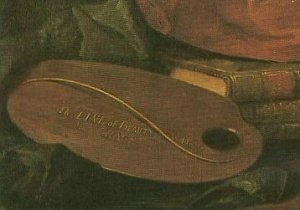
The text, also in gold, reads, “The line of beauty and grace,”and Hogarth adds his initials and dates the painting and the statement 1745. It would not be until eight years later that Hogarth published The Analysis of Beauty, the book that would elaborate on his theories of art-making and on the value of the simple and elegant line.
In his book, Hogarth praised, although not without reservation, what were called the Old Masters, those painters who can be characterized as having worked before the middle of the eighteenth century and, just as importantly, as not being English. But his career was in large part a competition with them, or if not with them, certainly with the English fascination for things French and Italian, and their resulting indifference to the works of contemporary English artists who departed from the tradition of the Old Masters.

This is an advertisement for an auction he held in 1745; called the Battle of the Pictures, it shows typical examples of history painting emerging from ranked files to fly through the air and assail his own works as they emerge from his studio, with the Old Masters losing out. This is brashly defensive, and reflects Hogarth’s frustration with his predicament: his painting was popular, but not prestigious. Rich buyers who bought portraits or lively satires from him bought their serious art from others; to Hogarth, this seemed like pretension, and he made it a subject for his own painting.

One of the first paintings that Hogarth made addressing the English gullibility before the authority of European culture is this, Taste a la Mode, from 1742. Commissioned by the heiress Mary Edwards, who was independent in her thinking about fashionable dress, and criticized by her friends for this independence, or indifference, it mocks the thoughtless embrace of imported styles that are ugly and impractical. The bizarrely wide hoop skirt of the woman on the left does not quite fit in the room; the older woman in the center wears an unflattering gown, adopts a mincing posture, drinks from an absurdly tiny cup, and believes that she is charming the fop who makes an affected bow to her. Here, above the mantel, a painting encapsulates the notion of sacrificing comfort for fashion’s sake: the cupid is carving a statue of a woman to fit the latest body shape, and the statue of the Venus de Medici is made ridiculous with high heels and a wide skirt that avoids the shape of her body altogether; we see her from behind, exposed, and humiliated. This painting, too, is ugly, travestying standard elements of Rococo painting in particular, and suggesting that a fashionable form comes at an unbearable price.

Hogarth frequently employed paintings within paintings. These serve to comment upon the action in the primary scene, most often, as in Taste a la Mode, in a critical way. It is in the third of his long progresses, narrative series that track a personal decline from its beginning to its messy conclusion, that he makes the most extensive use of secondary images as ironic commentary on the failings of his protagonists. Marriage a la Mode, published as a set of six engravings in 1745, contains some thirty paintings within it, and began as a set of paintings itself. Unusually, the paintings do not agree with the prints; it is as if Hogarth, who preferred at this time to be considered a painter rather than a printmaker, wished to distinguish the product of his own hand from the work he hired out to craftsmen to do.

Marriage a la Mode, like Hogarth’s earlier The Harlot’s Progress and The Rake’s Progress, is a serial narrative that condemns contemporary follies, and attacks institutional vices. Here, however, he begins on a more socially elevated plane, with the brokering of a marriage between the son of an earl in need of money (to finish the expensive enlargement of the house seen through the window), and the daughter of a merchant seeking prestige. It is an ill-advised pairing, as the young couple’s distance from one another suggests. This scene, like the others, is dense with layers of meaning that move in many ways: connections extend throughout the canvas, across the group as a whole, and into the rooms where these paintings were hung. Of particular interest here is the abundance of money and legal documents: they are all over the heart of the painting at the business table, and paintings are all over the walls. These are copies of old masters, for the most part; however, the largest is a portrait in the Italian manner of the bloated earl (who, in real life, indicates his branch on the family tree emerging from the hip of William the Conquerer and suffers badly from gout). The paintings are also documents of wealth and of prestige. Heedless acquisition for the sake of appearances is not merely foolish, but harmful; it is also the motivation for this marriage.

The other scenes track the dismal results of this union. Infidelity and sloth are suggested here, in the second scene, as the couple meets in the morning after a dissolute evening spent apart. Above the mantel a putto blows a set of bagpipes, a discordant instrument also associated with lust.
In the third scene, the young husband visits a doctor in a seedy room, apparently to seek out medicine to treat the syphillis he has passed along to his mistress, a child prostitute. (She dabs the sore at her lip.)
The fourth scene shows an entertainment held in the bedroom of the young wife, and alludes to the adultery that will, in the fifth scene, lead to the murder of the husband, who has surprised the lovers in their rented room, and has been stabbed to death; his murderer flees through the window.
This, in turn, results in the suicide of the wife, back at her own father’s house; she has swallowed arsenic after reading of the execution of her lover. The child of this marriage is held up to kiss her mother’s face; her only legacy is syphillis; the merchant pulls the wedding ring from his own daughter’s hand. This is where that story ends.

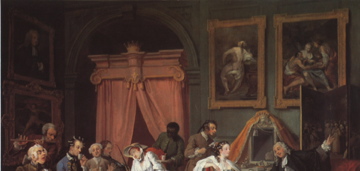
It is in the fourth scene that Hogarth delivers his most pointed commentary about the moral dangers of adopting foreign habits. A concert is in progress; a flautist accompanies a tenor, who is an import from Italy. The only figure listening is the woman in the center, who adopts a pose appropriate to one whose senses are being stirred; she is unsuitably abandoned, as her husband sits distinctly unmoved and clearly bored behind her in the corner. The hostess, her back turned to the performance and the emotion it elicits, is being prepared for an evening with her lover, who holds in his hand a ticket to a masquerade, and who gestures to a screen depicting this Venetian amusement.

All of the pictures in this scene, the most decadent of the series, are Italian, or of Italian origin; except, that is, for the portrait of the lover, hanging high upon the wall. And the openness of the adultery that the presence of this portrait implies is suggestive of the Venetian custom of the cicisbeo, the constant male companion of a married woman; the lover points to a Venetian image; the connection he has with the wife can only be justified under corrupt Venetian, and not solid English, circumstances. The masquerade on the screen sums up the nature of the whole of this scene, where Italian fashions rule: it is all pretension.

The other three paintings, too, allude to the falseness of this way of life. Each would have been recognizable to Hogarth’s audience as a copy of a well-known work. Here Hogarth ridicules the foolishness and poor judgement of those, like the duchess, who stock their big houses with paintings valued only because they resemble something much older, a precious and distant and safely tasteful original. Their subjects, too, biblical and mythological, are remote enough to be dignified, even as each treats of a seduction gone wrong. The duchess fails to recognize the correspondences between her own behavior and the behavior recorded in the high art on her walls. She does not see the pictures she buys; she is blinded by custom.


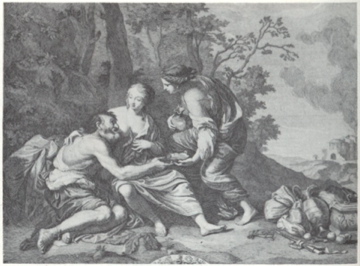
Beyond the scene of the masquerade is an image of Lot and His Daughters. The original, by Bernardo Cavallino, was sold in London in 1740; Hogarth may have seen it. A print after the painting, seen here, was made by Louis Guernier. The two daughters of Lot, believing that their father was the only man left alive in the world, serve him wine until he is insensible, and each lies with him, in order that they may bear children. The stor, from the book of Genesis, occurs after God’s destruction of Sodom and Gommorah, the cities of vice; the overlapping of the screen representing the Venetian masquerade, also a location given over to sin, assumes the place of the burning ruins in the original.


Behind the pair of the tenor and the flautist on the far wall is an image of Ganymede carried into the sky by Zeus. A drawing after Michelangelo, from the Royal Collection at Windsor, is the ultimate source; a copy of this very similar to Hogarth’s version, by Jan Swart van Groningen (c. 1530-40) (1500-60), is now at the Getty Museum; an engraved copy of this was made by Quirin Bol in the middle of the 17th century.


The landscape and the dog may have their origins in Correggio’s version of the abduction of Ganymede, part of his Loves of the Gods series from around 1531. What is hanging on this wall, then, is a third-generation copy, with interpolations. Its theme has direct applications to this scene, however; it appears behind the tenor, or castrato, a performer emasculated as a child in order to retain a pure, bright voice. The beak of the eagle ducks closely to Ganymede’s genitals, and suggests the same violence; Hogarth exaggerates the closeness and the implicit danger. (The rapt listener, her arms spread wide, also recalls the eagle: it is for this kind of adoration and aesthetic pleasure that the castrato suffered.) This is a profound sacrifice to make for art, a sexual alteration that jumbles traditional roles, and puts the subject in an ambivalent position. The duchess, too, by submitting to the customs imposed by culturally dominant, fashionably decadent Italy, has lost her place; she is not a wife here, and the rattle hanging from her chair reminds the viewer that there is a baby somewhere, too, and this baby does not have a suitable mother.


Above the duchess’s head, like a thought bubble revealing to us her deluded, aggrandized estimation of herself, is Io and Jupiter, a work that likely served as the companion piece to Correggio’s Zeus Abducting Ganymede, which appears here in a variation on the opposite wall. The figure in the painting repeats the duchess’s pose, twisted in a chair, arm flung back. Io accepts the advances of Jupiter in the same way that the duchess encourages the attentions of her lover. (The relation of his portrait on the wall to the classicized version of her in a frame repeats their connection again: the bed answers the mirror, and makes the existence of an erotic connection unmistakable.) Hogarth greatly exaggerates the presence of the hand of Jupiter within the cloud, making it flesh-colored, bony and corporeal, in a way that changes this from a divine seduction to a more human, and grosser, encounter.

This is certainly a comment on the relationship between the duchess and her lover, a deflation of her self-regard, a revelation of his nature. But this may have been as accurate a report as Hogarth could make of the original. He would never have seen the painting by Correggio (it has been in Vienna since 1601). There were many prints made after it, however, and these were available to him. These, too, make explicit what is only suggested in the painting. A version by F. van den Steen, from the middle of the seventeenth century, taken from a drawing of the painting, and a 1705 engraving, by Gaspard Duchange, give the god a distinctly human hand. The existence of a painted copy, with which Hogarth was familiar, and which perhaps emphasized the body within the cloud in the same way, can be assumed; Correggio was among those old masters most desired by British collectors of this time.


Hogarth makes reference to Correggio several times in the Analysis of Beauty. He praises the painter’s color sense and his use of the serpentine line, but, in the preface, criticizes some of his figures: the proportions, he writes, “are sometimes such as might be corrected by a common sign painter.” Later, he observes that any common sign painter “that lays his colors smooth, instantly becomes, in point of coloring, a Titian a Rubens, or a Correggio.”
There’s a desire here to demythologize the old masters. Yet it’s possible that Hogarth never saw the work of Correggio at all, and is evaluating his work on the basis of the copies and imitations that plagued his professional existence. The work by Correggio he singles out for praise, Juno and Ixion, is no longer given to the painter. In 1745, it does not seem that any works now attributed to Correggio were in England.
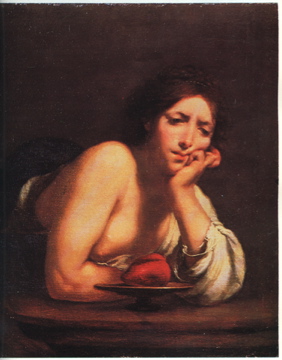
One supposed Correggio that caused Hogarth particular vexation was this: a painting from a story in Boccaccio’s Decameron, of Ghismonda Mourning the Heart of Giuscardo, (now attributed to the Florentine painter Francesco Furini). It was auctioned in 1756 as a Correggio; Hogarth thought, rather, that it was by a French painter, and was outraged by the price at which this work was sold: 404 pounds, 5 shillings. He set out to paint a picture of the same subject, but better, and English, for which he would be paid exactly as much. This is his version.

The model is his wife, Jane, and the princess Ghismonda here is less of a nymph, more of a lady, than the princess in the Old Master painting. Her distress is more apparent (the other woman looks merely piqued) and her relation to the heart is closer, as she draws it to her breast. Hogarth’s line of beauty flows throughout, and the setting and the objects are rich and elegant. Yet Hogarth lost this battle: his Ghismonda was criticized for falling far short of his model. He was humiliated when the patron refused to pay the price for it, and he abandoned history painting altogether. His wife kept this painting until long after his death, always hoping, for his sake, that it could get the 404 pounds, 5 shillings that had inspired it; in the end, it was sold for 58 pounds.
It is in his Modern Moral Subjects, like Marriage a la Mode, the series that allowed him the full scope of satire, where he bests his deceased competitors and their durable memory. Here he makes their work supplementary to his own; he manipulates it for his own purposes, and makes those great paintings small. Hogarth’s works have been compared to theater; but, unlike plays, in which the main action is isolated and performed by the actors on a stage meant only to provide for them a context, the action of Hogarth’s narrative paintings involves the whole space, and the props, too, are actors. The apparently peripheral elements of Marriage a la Mode contribute to the central narrative of the doomed marriage by suggesting the many varieties of vice and delusion that made such an arrangement seem reasonable. In this room where a meaningful connection to the conduct of a moral life is shown to have been frayed beyond repair, the pictures on the walls, neither modern nor moral, reveal themselves to be symptomatic of a visitation of folly as fierce as the descent of a brutal god, with results as damaging.